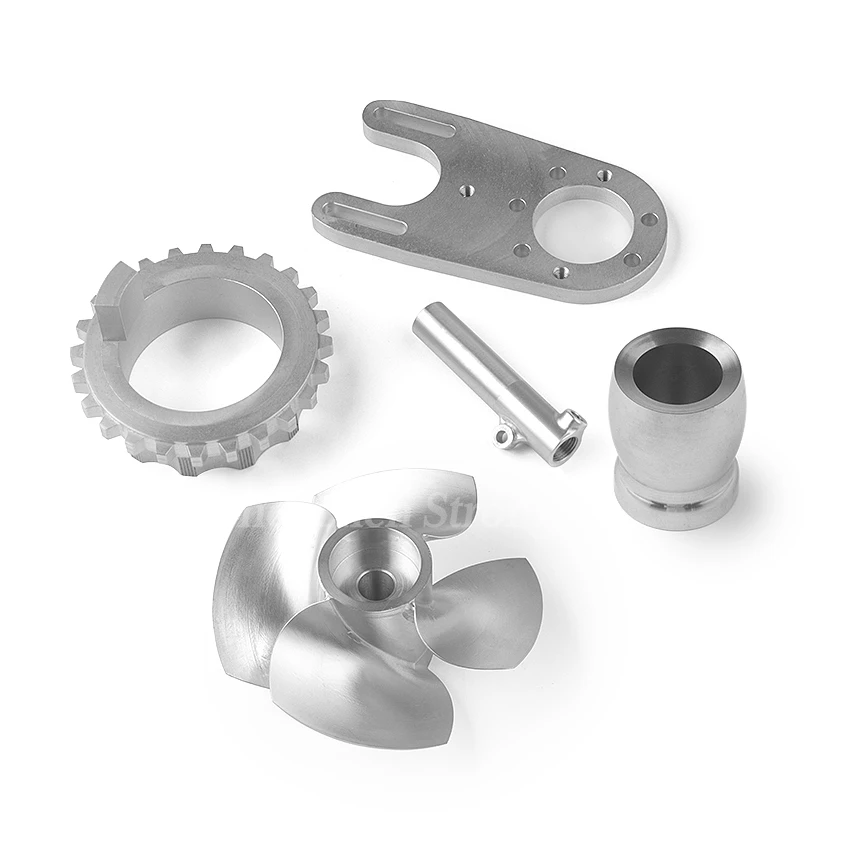


High standards for precision
Because they are directly tied to the motion precision and stability of the robot, metal parts for robots typically demand exceptionally high dimensional accuracy as well as form and position tolerances. For instance, it is typically necessary for joints, reducers, bearing seats, gears, and other components to have machining accuracy at the μm (micrometer) level.
Intricate arrangement
Robotic constructions typically contain intricate parts with a wide range of shapes. Common designs include curved surfaces, interior cavities, and unique holes, which place a high demand on processing technology and need the use of multi-axis CNC or compound machining centers. To completely satisfy the processing requirements of different product structures, Strongd is outfitted with 3-axis, 4-axis, and 5-axis CNC machines.


Use of various materials
Robot metal parts may be made of aluminum alloy, stainless steel, carbon steel, titanium alloy, high-strength steel, or another material, depending on their intended application. This necessitates the use of processing equipment that is versatile in terms of materials. Strongd can help you process numerous materials.
Small batches and many kinds
Parts are frequently produced in small batches and in various kinds, emphasizing flexibility and rapid switching, particularly in the customized robot and high-end robot sectors. Strongd can complete the first sample for you within three days at the most.
High surface quality requirements
Robot parts, particularly moving and connecting parts, require high surface roughness (Ra<0.8μm). Additionally, some important elements require precision polishing, heat treatment, or surface coating.
Advantages
Improve robot performance
High-precision metal processing allows the robot to run more steadily, respond faster, and have greater repeat positioning accuracy, allowing it to operate in complex or high-load circumstances.
Ensure great reliability
Reliable metal parts can greatly lower the robot's failure rate and maintenance expenses while in operation, as well as lengthen the whole machine's service life.
High customizability
Robotic metal parts processing may be easily adjusted in size, shape, and structure to meet unique needs, making it ideal for collaborative robots, medical robots, industrial robots, and other industries that require great functional distinction.
Adapt to various processing methods
Including:
CNC Milling
CNC Turning
Electric discharge machining (EDM)
Laser-cutting and welding
5 axis processing
Stamping, heat treatment, sandblasting, and electroplating are some examples of post-processing procedures.
Improve the parts' overall performance.
Compatible with automated production lines
The MES system can be used in batch processing of robot components to enable production visualization, data traceability, and full-process quality control, resulting in intelligent manufacturing.
Adaptable to multiple industry applications
Robotic metal parts can be widely used in
Industrial manufacturing (welding and handling robots)
Medical industry (surgical and rehabilitative robots)
Agriculture (picking and spraying robots)
Service industry (welcoming and cleaning robots)
Military industry and aerospace (specialized robots)
Superior strength and durability
Metal parts are more stable in shock, vibration, and high temperature conditions than plastics or composite materials.
FAQ
Hot Tags: robot metal parts manufacturing, China robot metal parts manufacturers, suppliers, factory, Aluminium Robot Chassis, Mechanical Robotic Parts, Metal Robot Body Parts, Robot Metal Parts Manufacturing, Stainless Steel Metal Robot Parts, Surgical Robots Parts