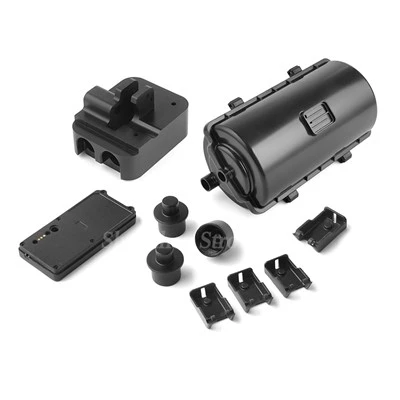


Products Description

Vacuum Casting Soft Rubber Products refer to flexible components manufactured using the vacuum casting process with soft rubber, rubber-like, or elastic polyurethane materials as raw materials. These products are typically formed using silicone molds, where liquid material is poured under vacuum conditions to replicate the structure, texture, and dimensional details of the original prototype.
Compared to traditional injection-molded soft rubber parts, vacuum-cast soft rubber products are better suited for projects requiring small batches, multiple variants, and rapid design validation. Their materials can simulate various rubber properties, such as soft tactile feel, high elasticity, abrasion resistance, tear resistance, and moderate oil resistance and aging resistance. They meet diverse needs including functional testing, appearance evaluation, and market validation.
In practical applications, Vacuum Casting Soft Rubber Products are not only used for final functional parts but also commonly employed in Engineering Verification Tools (EVTs), Design Verification Tools (DVTs), and small-batch trial production phases. This enables customers to thoroughly validate product design feasibility and market acceptance before proceeding with formal tooling.
Advantages and Features
1. Low Cost, High Cost-Effectiveness
Vacuum casting eliminates the need for expensive steel molds, requiring only silicone molds for production. This significantly reduces upfront investment costs, making it particularly suitable for startup projects or new product development phases.
2. Fast turnaround and flexible response
Typically requiring only 7–15 days from 3D data to finished product, we can swiftly address urgent customer needs and accelerate time-to-market.
3. Diverse Material Options
Multiple soft rubber and rubber-like materials are available, offering a wide range of hardness levels (Shore A 10–90) to simulate the distinct tactile sensations and properties of TPR, silicone, rubber, and other materials.
4. High Fidelity to Original Appearance
Silicone molds excel at replication, accurately reproducing the texture, chamfers, logos, and intricate details of the original part with superior surface quality.
5. Suitable for small-batch production
A single mold typically produces 15–30 pieces, making it ideal for multiple iterations and version testing while avoiding inventory pressure.
Production Process Flow
Prototyping
n of power distribution systems for the petrochemical industry.
01
Silicone Mold Fabrication
Secure the master mold within the mold frame, pour liquid silicone rubber, and cure it to form a reusable silicone mold.
02
Vacuum Infusion
Under vacuum conditions, pre-mixed soft gel material is injected into the mold, effectively preventing air bubbles and enhancing the quality of the finished product.
03
Curing and Molding
The material cures at room temperature or under heated conditions to form the final soft rubber components.
04
Post-Processing
This includes deburring, surface finishing, spraying, coloring, screen printing, or simple assembly to meet customers' further requirements for appearance and functionality.
05
Application Scenarios
Vacuum-cast soft rubber products are widely utilized across multiple industries due to their flexibility and high adaptability:

01
Consumer Electronics
Protective cases, seals, buttons, cushioning pads
02
Medical Devices
Medical-grade silicone housings, flexible connectors, testing components
03
Automotive Industry
Sealing rings, shock absorbers, interior soft rubber components
04
Industrial Equipment
Anti-slip mats, flexible protective sleeves, cushioning assemblies
Customization Services
We provide clients with one-stop customization services covering every stage from design to delivery:
Material Customization
Tailored to specific hardness, color, texture, and performance requirements
Structural Optimization Recommendations
Assisting in design refinement based on vacuum forming process characteristics
Surface Finishing
Painting, rubber oil coating, matte/gloss effects
Flexible Small-Batch Delivery
Supporting multiple versions, colors, and low-volume production
Quality Control

To ensure the stability and consistency of Vacuum Casting Soft Rubber Products, we have established a comprehensive quality control system:
- Raw material incoming inspection
- 100% sampling inspection of critical dimensions and appearance
- Hardness, elasticity, and functional testing
- Comprehensive re-inspection prior to shipment
Each batch of products is completed under controlled processes, ensuring every component delivered to customers meets expected standards.
FAQ
Q1: Can vacuum-formed soft rubber parts be used as final products?
A: They can be used in certain low-load or non-long-term applications, but are generally more suitable for prototyping and small-batch testing.
Q2: What is the maximum quantity per run?
A: We generally recommend 15–30 pieces per mold set. For larger quantities, multiple mold sets can be produced.
Q3: Can colors be customized?
A: Yes, we support Pantone color matching or sample comparison.
Q4: How does it differ from injection-molded soft rubber?
A: Vacuum casting offers lower costs and shorter lead times but is not suitable for high-volume, long-term production.
Hot Tags: vacuum casting soft rubber products, China vacuum casting soft rubber products manufacturers, suppliers, factory, Silicon Rubber Casting, vacuum casting, Vacuum Casting Of Rubber Shell Parts, Vacuum Casting Rubber For Medical Products, vacuum casting rubber parts, Vacuum Casting Silicone Mold