

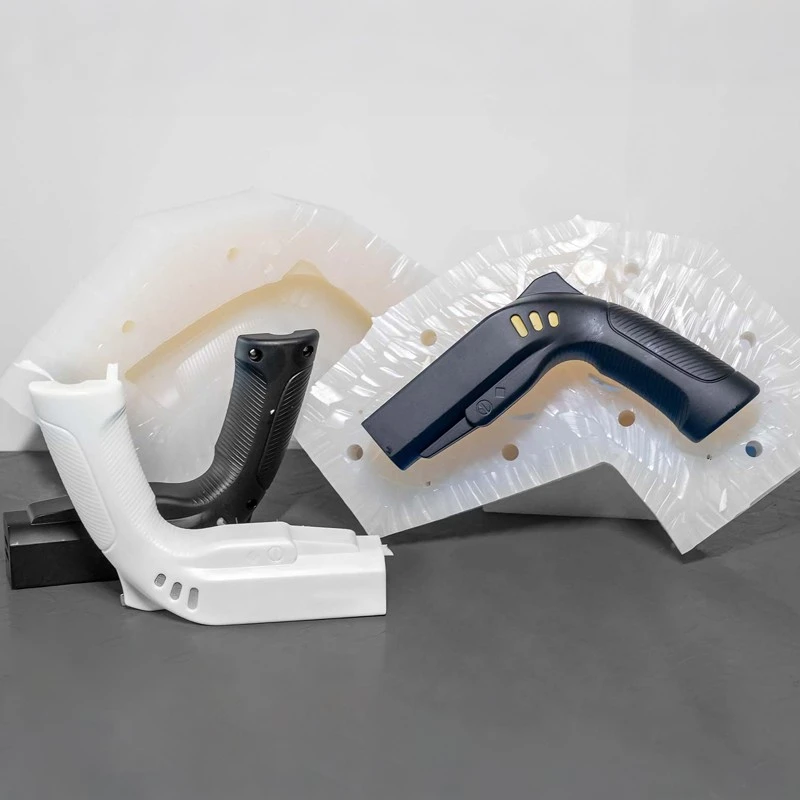

Vacuum Casting automotive shell refers to automotive shell parts produced by vacuum casting. Vacuum casting is a rapid mold manufacturing technology, which is often used in small-batch production of plastic parts, verification of prototype structure, production of functional samples, etc. The principle is to first use a prototype (usually made by 3D printing or CNC machining) to make a master mold, and then use liquid silicone for negative mold casting, which forms a silicone mold after curing, and then use the vacuum casting process to inject polyurethane, ABS, transparent or high-strength materials into the mold to replicate multiple high-precision parts, which is particularly suitable for structure verification, appearance confirmation, concept verification and market testing.
Compared with traditional injection molding, it has the characteristics of low investment, fast cycle and high quality, which brings a flexible and efficient product realization path for enterprises.
About Strongd, we have a professional mold technology team, a full-process management system and a rich selection of materials. We can provide customers with one-stop services from design evaluation, proofing testing to mass production, helping customers accelerate their product implementation.
Vacuum casting achieves an optimal balance among precision, flexibility, efficiency, and cost-effectiveness, offering the following distinct benefits:
Advantages
Vacuum Casting ABS Shell material can balance strength and toughness and is suitable for most structural parts.
High-precision replication with exact dimensional match
Utilizing advanced silicone molding technology, we replicate automotive shell parts with exceptional accuracy based on original factory components or precise 3D models. Through professional mold-making and casting processes, we ensure every detail is faithfully reproduced.
01
Premium Material Selection for Exceptional Performance and Reliability
We meticulously source high-quality composite materials-such as ABS, PC, and carbon fiber composites-for production. All materials undergo rigorous performance testing, ensuring outstanding impact resistance, temperature tolerance, corrosion resistance, and durability.
02
Rapid Response Production with Short Lead Times
Compared to traditional mold production methods, the replica molding process eliminates the need for costly steel molds, significantly shortening mold preparation time while enabling rapid small-batch and multi-cycle production. For urgent customer demands, we can complete mold fabrication and sample production within 3–7 days, with bulk order lead times streamlined to just 10–15 days. This dramatically reduces customer waiting periods, empowering clients to accelerate project timelines and seize market opportunities swiftly.
03
Outstanding Cost-Effectiveness and Controllable Expenses
The mold fabrication cost for replica molding is significantly lower than that of traditional steel molds, making it particularly suitable for small-batch production (10–1,000 units). This helps clients effectively reduce initial investment costs. Moreover, by optimizing production workflows and enhancing efficiency, we further control manufacturing expenses without compromising product quality, delivering exceptional value for money. Whether for small-batch custom orders from individual automotive enthusiasts or for corporate R&D prototypes and limited production runs, we ensure an optimal balance between cost and quality.
04
Diverse Surface Finishes for Personalized Customization
We support a wide range of surface treatment processes, including painting, electroplating, brushing, sandblasting, and carbon fiber texture wrapping. Customization options for colors, textures, and styles are available to meet specific client requirements. Whether the goal is a subtle, factory-style finish or a bold, customized look for modifications, we ensure precise execution. Additionally, we can incorporate logos, markings, and other detailed designs on the shell surface as needed, enhancing product recognition and exclusivity.
05
Standardized Production Process: Rigorous Control Ensures Consistent Quality
We have established a comprehensive standardized production process, implementing stringent quality control at every stage from prototype development to final delivery. This ensures stable and reliable product quality.
1. Requirement Communication and Solution Design
We engage in in-depth discussions with clients to clarify their needs-such as product model, dimensions, materials, surface finishes, batch size, and delivery timelines. Based on the product's application scenario, we provide professional tailored solutions. If a ready-made prototype is unavailable, we can perform 3D scanning and modeling using client-provided drawings or samples to complete prototype design.
2. Prototype Production and Inspection
Prototypes are fabricated using 3D printing technologies (e.g., SLA, SLS). Upon completion, precise dimensional inspections are conducted using professional equipment such as coordinate measuring machines (CMM) to ensure compliance with design specifications. Any dimensional deviations are promptly adjusted and optimized.
3. Mold Fabrication and Curing
Approved prototypes undergo surface preparation (e.g., sanding, polishing, mold release agent application) before being placed into mold frames. Silicone material is then poured into the mold frame, followed by vacuum degassing to eliminate air bubbles and ensure uniform silicone mold texture. The silicone mold is subsequently cured in a temperature-controlled chamber. After curing, the mold is separated from the prototype, yielding an accurate silicone mold.
4. Casting and Demolding
Based on client requirements, suitable materials (e.g., ABS resin, PC resin, carbon fiber composites) are selected, heated to a molten state, and poured into the silicone mold. Vacuum degassing and constant-temperature curing are performed to ensure complete mold filling, resulting in bubble-free, dense finished products. Once cured, demolding is carried out to obtain initial molded parts.
5. Post-Processing and Quality Inspection
Initial molded parts undergo post-processing steps such as sanding, trimming, polishing, and deburring to enhance surface smoothness and aesthetic appeal. A comprehensive quality inspection follows, including dimensional verification (via CMM), visual checks (for scratches, deformations, color variations, etc.), and performance testing (e.g., impact resistance, temperature tolerance). Only products passing these inspections proceed to the next stage.
6. Surface Treatment and Packaging Delivery
Surface finishing processes (e.g., painting, electroplating, brushing) are applied according to client specifications. After surface treatment, a final visual inspection ensures alignment with client expectations. Products are then professionally packaged (with shockproof and moisture-resistant materials) and arranged for logistics delivery as per client requirements, ensuring safe and timely receipt.
Information for Quotation
1.3D Model Files: preferred formats will be .STEP / .IGS / .STL
2.Part Quantity
Specify the required number of replicated parts to determine:
①Suitable mold lifespan
②Optimal number of casting cycles
3.Material & Performance Requirements
Special properties needed:
①High transparency
②Flame retardancy
③Flexibility (e.g., Shore hardness)
④Custom coloring
4.Surface Finish & Color Treatment
Specify desired appearance:
①Painting (Pantone/RAL color matching)
②Clear/transparent finish
③Metallic effects (e.g., vacuum plating)
5.Delivery Timeline
Required lead time to facilitate production scheduling
6.Operating Environment Details
Critical conditions: Temperature range and mechanical load requirements
FAQ
Hot Tags: automotive shell vacuum casting, China automotive shell vacuum casting manufacturers, suppliers, factory, Silicone Mold Plastic Casting, Silicone Mould Parts, Vacuum Casting Components, Vacuum Casting Parts, Vacuum Casting Plastic Case, vacuum casting plastic parts


