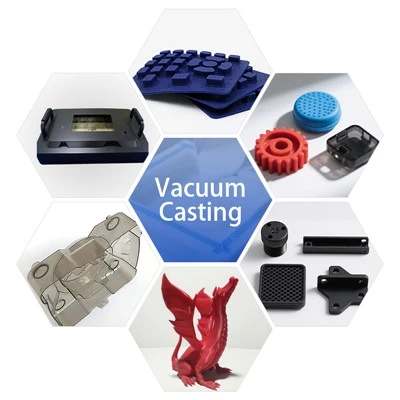

Silicon rubber casting is a well - known manufacturing process that has found its way into various industries. As a supplier of silicon rubber casting services, I often get asked some interesting questions, and one that pops up quite a bit is, "Can silicon rubber casting be used for casting semiconductors?" Let's dig into this topic and see what we can find out.
First off, let's understand what silicon rubber casting is all about. It's a process where a silicone rubber mold is created from a master pattern. Then, a liquid material is poured into this mold and allowed to cure, taking the shape of the mold. This technique is popular because it's relatively inexpensive, can produce high - quality parts with good detail, and is suitable for small - to - medium production runs. You can learn more about it on our Silicon Rubber Casting page.
Now, semiconductors are a whole different ballgame. These are materials that have electrical conductivity between that of a conductor (like copper) and an insulator (like rubber). They're the heart and soul of modern electronics, used in everything from smartphones to computers and even cars. The manufacturing of semiconductors is a highly precise and complex process that requires extremely clean environments, tight control over material properties, and advanced technologies.
So, can silicon rubber casting be used for casting semiconductors? Well, on the surface, there are some challenges. Semiconductor manufacturing demands a level of purity that's hard to achieve with silicon rubber casting. The process of pouring liquid into a rubber mold can introduce impurities, which can have a huge impact on the performance of the semiconductor. Even a tiny impurity can cause a semiconductor to malfunction, and silicon rubber casting just doesn't have the same level of control as the specialized semiconductor manufacturing processes.
Another issue is the precision required. Semiconductor components are often incredibly small, with features measured in nanometers. Silicon rubber casting, while it can produce parts with good detail, isn't typically capable of reaching the nanoscale precision needed for semiconductors. The rubber mold itself can have some degree of flexibility, which might lead to dimensional inaccuracies when trying to create such tiny and precise components.
However, that doesn't mean there's no potential at all. In some cases, silicon rubber casting could be used for non - critical parts of semiconductor devices. For example, it could be used to create some of the housing or support structures around the semiconductor chips. These parts don't need the same level of electrical conductivity or precision as the actual semiconductor components themselves.
Let's take a look at some of the advantages of silicon rubber casting that could potentially be useful in the semiconductor field. One of the big pluses is the ability to quickly produce prototypes. If a semiconductor company is working on a new design, they can use silicon rubber casting to quickly create a physical model of the housing or other non - critical parts. This allows them to test the form and fit of the design before investing in more expensive and time - consuming manufacturing processes. You can read more about the casting process for rubber parts on our Vacuum Casting Of Rubber Shell Parts page.
Silicon rubber casting also offers a wide range of material options. Different types of silicone rubbers can be used, each with its own set of properties such as flexibility, hardness, and heat resistance. This means that depending on the requirements of the semiconductor device, a suitable rubber material can be chosen for the non - critical parts.
In the medical field, silicon rubber casting has been used for various applications, as seen on our Vacuum Casting Rubber for Medical Products page. The same principles of using silicon rubber casting for non - critical but functional parts could potentially be applied to the semiconductor industry. For example, just like in medical products where rubber parts need to be biocompatible and have certain mechanical properties, in semiconductor devices, the non - critical parts might need to have specific thermal or mechanical characteristics.
When it comes to cost, silicon rubber casting is generally more affordable compared to some of the high - end semiconductor manufacturing processes. For semiconductor companies looking to reduce costs on non - critical components, silicon rubber casting could be an attractive option. It allows for small - batch production without the need for expensive tooling, which can be a big advantage, especially for startups or companies working on new product development.
But we also need to be realistic about the limitations. As mentioned earlier, the lack of precision and potential for impurities are significant hurdles when it comes to using silicon rubber casting for actual semiconductor components. The semiconductor industry has its own well - established manufacturing methods, such as photolithography and chemical vapor deposition, which are designed to meet the strict requirements of semiconductor production.
In conclusion, while silicon rubber casting can't be used for casting the core semiconductor components themselves, it does have potential for non - critical parts in semiconductor devices. It offers benefits like quick prototyping, a variety of material options, and cost - effectiveness. If you're in the semiconductor industry and are looking for a solution for non - critical parts, we'd love to have a chat with you. Whether you need prototypes or small - batch production, our silicon rubber casting services could be just what you need. Reach out to us to start a discussion about your specific requirements.


References
- General knowledge of semiconductor manufacturing processes from industry textbooks and research papers.
- Information on silicon rubber casting based on our company's experience and in - house knowledge.