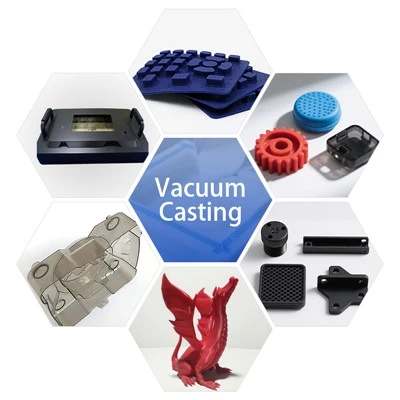

Hey there! As a supplier of Vacuum Casting Parts, I often get asked about the shrinkage rate of these parts. It's a super important topic, especially if you're looking to get high - quality vacuum - cast products. So, let's dive right in and explore what the shrinkage rate of vacuum casting parts is all about.
What is Vacuum Casting?
First off, let me quickly explain what vacuum casting is. Vacuum casting is a process used to create high - quality, detailed parts from a master pattern. We start by making a silicone mold from the master pattern. Then, we pour a liquid resin into the mold under vacuum conditions. This helps to remove any air bubbles and ensures that the resin fills every nook and cranny of the mold. Once the resin cures, we get a part that's an exact replica of the master pattern. You can check out some of our Silicone Mould Parts to see the kind of quality we're talking about.


Understanding Shrinkage Rate
The shrinkage rate of vacuum casting parts refers to the percentage by which the part shrinks in size after the resin has cured. It's a natural phenomenon that occurs due to the chemical and physical changes that take place during the curing process. When the liquid resin turns into a solid, the molecules rearrange themselves and come closer together, which causes the part to shrink.
The shrinkage rate is usually expressed as a percentage. For example, if a part has a shrinkage rate of 0.5%, it means that for every 100 millimeters of the original size, the part will shrink by 0.5 millimeters after curing.
Factors Affecting Shrinkage Rate
There are several factors that can affect the shrinkage rate of vacuum casting parts. Let's take a look at some of the most important ones:
Resin Type
Different types of resins have different shrinkage rates. For instance, polyurethane resins, which are commonly used in vacuum casting, typically have a shrinkage rate ranging from 0.1% to 0.5%. Epoxy resins, on the other hand, may have a slightly different shrinkage rate, usually between 0.2% and 0.6%. The choice of resin depends on the specific requirements of the part, such as its mechanical properties, chemical resistance, and appearance. If you're interested in plastic electronic shells made through vacuum casting, you can check out our Vacuum Casting Plastic Electronic Shell products.
Curing Conditions
The curing conditions, such as temperature and time, also play a significant role in the shrinkage rate. Higher curing temperatures generally lead to faster curing, but they can also cause the part to shrink more. This is because the increased temperature speeds up the chemical reactions in the resin, causing the molecules to rearrange more quickly and come closer together. Similarly, longer curing times can also result in more shrinkage. It's important to find the right balance between curing speed and shrinkage to get the best results.
Part Geometry
The shape and size of the part can affect the shrinkage rate as well. Parts with complex geometries or thick sections may experience uneven shrinkage. This is because the resin in different areas of the part may cure at different rates, leading to variations in shrinkage. For example, thick sections may take longer to cure, and as a result, they may shrink more compared to thinner sections.
Mold Material
The material of the mold can also have an impact on the shrinkage rate. Silicone molds, which are commonly used in vacuum casting, are flexible and can accommodate some of the shrinkage of the part. However, if the mold is too rigid, it may restrict the shrinkage of the part, leading to internal stresses and potential warping.
Measuring Shrinkage Rate
Measuring the shrinkage rate of vacuum casting parts is crucial to ensure that the final parts meet the required specifications. There are several methods to measure the shrinkage rate:
Dimensional Measurement
The most straightforward method is to measure the dimensions of the part before and after curing. You can use precision measuring tools such as calipers or micrometers to measure the length, width, and height of the part. Then, you can calculate the shrinkage rate using the following formula:
Shrinkage Rate (%) = [(Original Dimension - Final Dimension) / Original Dimension] x 100
Comparison with Master Pattern
Another method is to compare the vacuum - cast part with the master pattern. You can use a coordinate measuring machine (CMM) to accurately measure the dimensions of both the part and the master pattern. By comparing the two, you can determine the shrinkage rate.
Controlling Shrinkage Rate
Controlling the shrinkage rate is essential to produce high - quality vacuum casting parts. Here are some ways to control the shrinkage rate:
Resin Selection
Choose a resin with a low shrinkage rate that meets the requirements of your part. You can consult with resin manufacturers or suppliers to get recommendations based on your specific needs.
Curing Optimization
Optimize the curing conditions, such as temperature and time, to minimize shrinkage. Conduct tests to find the ideal curing parameters for your resin and part geometry.
Design Modification
Modify the design of the part to reduce the risk of uneven shrinkage. For example, you can add ribs or fillets to thick sections to improve the flow of the resin and promote more uniform curing.
Importance of Shrinkage Rate in Vacuum Casting
Understanding and controlling the shrinkage rate is crucial for several reasons:
Dimensional Accuracy
If the shrinkage rate is not properly controlled, the final parts may not meet the required dimensional specifications. This can lead to fit issues, especially if the parts need to be assembled with other components.
Quality and Appearance
Uneven shrinkage can cause warping, cracking, or other defects in the part, which can affect its quality and appearance. By controlling the shrinkage rate, you can ensure that the parts have a smooth finish and are free from defects.
Cost - Effectiveness
Producing parts with the correct shrinkage rate reduces the need for rework or scrap, which can save time and money in the long run.
Conclusion
In conclusion, the shrinkage rate of vacuum casting parts is an important factor that can significantly affect the quality and dimensional accuracy of the final products. As a supplier of Vacuum Casting Parts, we understand the importance of controlling the shrinkage rate and use advanced techniques and materials to ensure that our parts meet the highest standards.
If you're in the market for high - quality vacuum casting parts, whether it's Vacuum Casting Plastic Electronic Shell or Vacuum Casting ABS Shell, we're here to help. We can work with you to understand your specific requirements and provide you with the best solutions. Don't hesitate to reach out for a quote or to discuss your project in more detail. We're looking forward to working with you!
References
- "Vacuum Casting Technology" - A technical guide on vacuum casting processes and materials.
- Resin manufacturer's datasheets for information on resin shrinkage rates.